
How Standalone Air Purifiers Work: Fans, Filters and Room Coverage
Standalone air purifiers are often chosen when a room needs extra filtration without changing the building’s ducted system. They are relatively simple machines, but the way the fan, filter and room layout work together has a big impact on performance.
If you are comparing units for a home, office, clinic or meeting room, it helps to understand what the purifier is actually doing, what type of filter it uses, and whether it is sized for the space and the contaminant you want to capture.
What a standalone air purifier actually does
A room air purifier draws air into the unit with a fan, passes that air through one or more filters, and then sends the cleaned air back into the room.
The basic idea is straightforward, but performance depends on several parts working together:
- •Air intake brings room air into the unit
- •Pre-filter captures larger dust, lint and debris so the main filter lasts longer
- •Main filter captures finer particles depending on its rating and media type
- •Fan and motor move air through the filter and back into the room
- •Cabinet design affects airflow, noise and how well the unit circulates air
The cleaner the air delivery path and the better the fit between fan and filter, the more effective the unit is likely to be in real use.
The main components: fan, filter and housing
The fan sets airflow
The fan is what pulls air through the purifier. A unit with a strong fan does not automatically perform better, because the fan also has to push air through the resistance of the filters.
If the filter is too restrictive for the fan, airflow drops. If airflow is too low for the room, the unit may not circulate enough air to make a practical difference in day-to-day use.
For offices and shared spaces, noise can also matter. A quieter unit may be left running more consistently, while a noisy one may be turned off or set too low.
The filter does the capturing
Different filters are designed for different particle sizes and different contaminants.
Common filter types include:
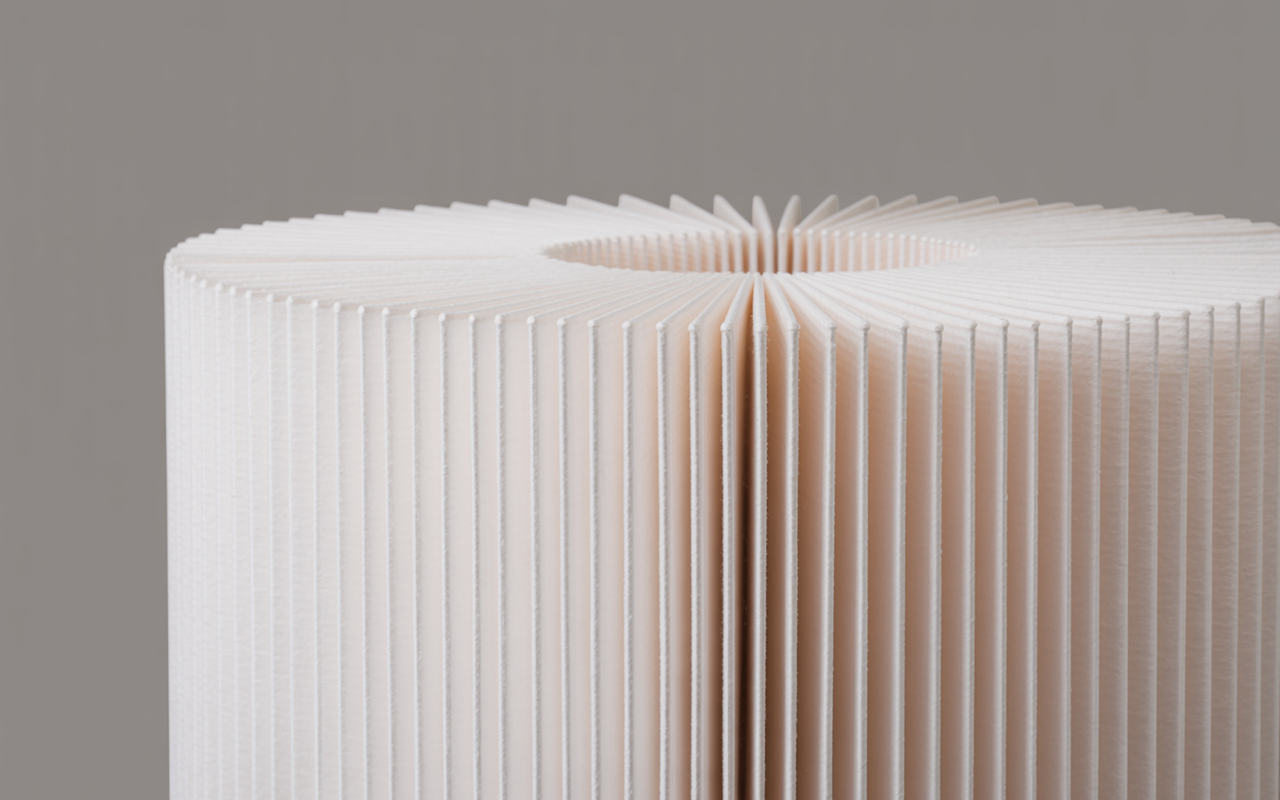
- •Pleated particulate filters for general dust and fine particles
- •Carbon or adsorption media for some odours and certain gaseous contaminants
- •HEPA filters for applications needing high particle capture efficiency
HEPA filters are used where fine particle capture is important. Under EN 1822, H13 filters are at least 99.95% efficient at the most penetrating particle size, and H14 filters are at least 99.995% efficient at the most penetrating particle size.
That said, not every room needs HEPA. The right choice depends on what you are trying to capture and how much airflow the unit can maintain through the filter.
The housing affects how air moves
The cabinet is more than a shell. It shapes how air enters, how evenly it passes through the filter, and how clean air is discharged back into the room.
A well-designed housing can help avoid short-circuiting, where air moves from intake to outlet too quickly without mixing through the room properly.
Matching the purifier to the room
A common mistake is choosing a purifier by appearance or by a single feature such as “HEPA” without considering the room itself.
To match a unit properly, think about:
- •Room size and layout
- •Ceiling height
- •Whether doors are open or closed most of the time
- •How many people occupy the space
- •How much dust or airborne material is generated
- •Where the purifier will sit in the room
A small bedroom, a reception area and an open-plan office all behave differently. A unit that seems powerful in a small enclosed room may be underdone in a larger or more open space.
If you are unsure what size to choose, it can help to think about air changes and room coverage in practical terms: the purifier must move enough air through its filter and circulate it through the occupied area.
Placement matters as much as the unit size
Where you place the purifier can make a noticeable difference.
Good placement usually means:
- •Allowing space around the intake and discharge points
- •Avoiding corners where airflow can be blocked
- •Keeping the unit away from furniture that restricts circulation
- •Considering where people actually sit or work
In offices, placement is often a balancing act between airflow, noise and access for maintenance.
Choose the filter type for the contaminant
Different contaminants call for different filter media and purifier setups.
Dust and general airborne particles
For everyday dust, lint and fine household particles, a particulate filter with suitable efficiency is usually the starting point. A pre-filter can be useful because it captures larger material before it reaches the main filter.
Smoke and very fine particles
Smoke particles are typically smaller and may require higher-efficiency filtration. In these situations, the main filter rating and the fan’s ability to maintain airflow through the filter are both important.
Odours and some gases
If the problem is odour rather than dust, a particle filter alone may not be enough. Some units use carbon or other adsorption media to help with certain odours and gaseous contaminants.
That media has its own limits and loading behaviour, so it should be matched to the actual contaminant rather than assumed to solve every issue.
Mixed contamination
Many real spaces have more than one issue at once, such as dust plus odour, or fine particles plus general debris. In those cases, a multi-stage purifier can be more appropriate than a single-filter unit.
Maintenance, access and filter monitoring
A room purifier is only effective if it is maintained. As filters load with dust, airflow can fall and the unit may become noisier or less effective at moving air.
It is better to inspect filters based on the system, the site conditions and the dust load rather than relying on a fixed calendar alone. Follow the filter or equipment manufacturer’s instructions, and monitor pressure drop where gauges are fitted.
Useful maintenance points include:
- •Checking whether the pre-filter can be cleaned or replaced
- •Inspecting seals and filter fit to avoid bypass
- •Listening for changes in fan noise that may indicate restriction
- •Confirming that the unit is still moving air as intended
Some filters are designed to be washable - check the product instructions before attempting to clean them.
For workplaces, regular servicing is often easier to manage when filters are selected with access and replacement in mind. If you need support with ongoing upkeep, see filter servicing or commercial filter servicing.
Standards, systems and practical fit-out decisions
In commercial buildings, room purifiers should be considered alongside the overall ventilation and air movement strategy. Site requirements should be confirmed with the mechanical services engineer or building owner, especially where the space is governed by project specifications or building management rules.
AS 1668.2:2024 is often relevant when thinking about ventilation in occupied buildings, but a standalone purifier is only one part of the picture. It may supplement existing systems, not replace them.
For that reason, it is worth checking:
- •Whether the purifier is intended as a supplement or a primary room unit
- •Whether it fits the available footprint and power supply
- •Whether noise levels are acceptable for the space
- •Whether the filter type suits the contaminant load
- •Whether maintenance staff can access the filters easily
If you are planning a new fit-out or replacing existing filters for an occupied space, our products and custom air filters may help you narrow the options.
Getting the right unit for home or office use
A good standalone air purifier is not just about a high-efficiency filter. It is the combination of airflow, filter type, cabinet design and room fit that determines whether the unit is suitable.
For homeowners, that often means choosing a unit that suits the room size and the type of particles or odours present. For office managers, it also means considering layout, maintenance access and how the purifier will work alongside existing ventilation.
If you are measuring an existing filter or comparing replacement options, our guide on how to measure an air filter can help.
Need help choosing the right filter or purifier setup?
Total Air Filtration is a family-owned air filter manufacturer and supplier in Hillcrest, Brisbane QLD, established 2009.
If you need guidance on room air purifiers, replacement filters or a custom-made solution, we can help supply or make the right filters for your application. Call 07 3800 3448 or request a quote. You can also contact us to discuss your space and contaminant type.
Written by
The Total Air Filtration Team
General information only — always follow the instructions for your filter and system. Have questions about this article? We're here to help.