
What Mechanical Contractors Should Know About Filters for Split Systems in Rental Units
Split system filters in rental units seem simple until access, measurement and maintenance responsibilities get in the way. For mechanical contractors and landlords, the right filter choice is about more than airflow; it needs to suit the unit, the tenancy setup and the practical realities of servicing the property.
At Total Air Filtration, a family-owned air filter manufacturer and supplier in Hillcrest, Brisbane QLD, we see these issues come up often when owners want a straightforward solution that actually fits the equipment and the site.
Why rental properties need a different approach
In investment properties, the filter is often treated as a generic consumable, but split systems are not all built the same. Access can be awkward, some indoor units have limited clearance, and tenants may not know where the filter sits or how to remove it without damaging clips, panels or the filter frame.
That means the filter specification should be chosen with the property in mind, not just the indoor unit model.
Key points to consider:
- •Can the tenant access the filter without tools?
- •Is there enough space to remove and refit the filter without bending it?
- •Does the unit use a standard size, or will a custom filter be needed?
- •Is the filter intended to be disposable, or is a washable product suitable for the specific application?
- •Will the filter load up quickly because of dust, pet hair or nearby works?
For landlords, the practical goal is to keep the system serviceable between visits. For contractors, the goal is to specify something that can be maintained without repeated call-backs.
Access issues that are easy to overlook
The most common problem in rental properties is not the filter media itself, but getting to it.
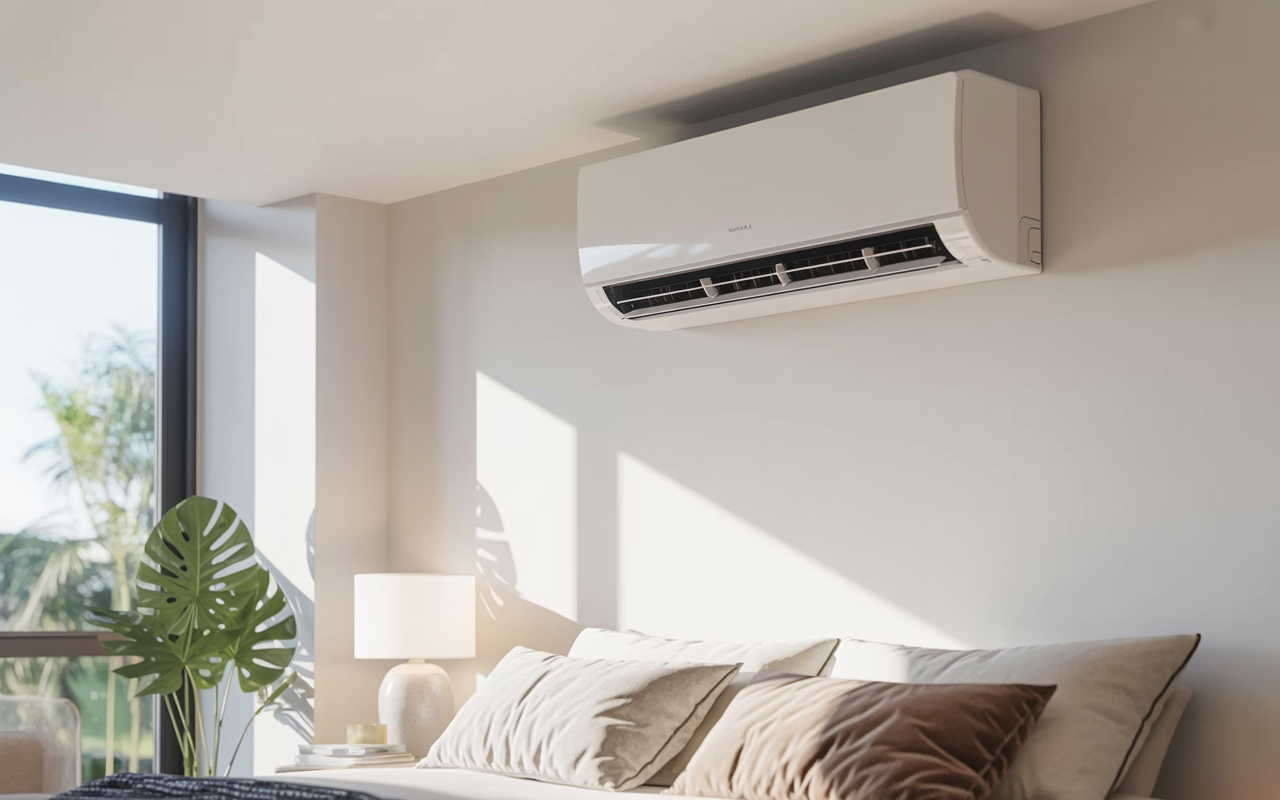
Wall-mounted split systems often rely on a front panel that folds up to expose the filter. In practice, that may be difficult if the unit is installed close to a ceiling, shelf, wardrobe or curtain track. In some apartments and townhouses, the indoor unit is mounted where a tenant can only partially open the panel, making regular inspection frustrating.
When you are assessing access, look at:
- •panel opening clearance
- •how the filter locks in place
- •whether the filter frame can be removed without flexing
- •whether tenant instructions need to be left in writing
- •whether maintenance staff can inspect it safely without moving furniture
If access is poor, a standard off-the-shelf replacement may not be the best option. A correctly measured custom filter can make servicing easier and reduce the chance of poor fit or bypass around the frame. If you need help measuring, see how to measure an air filter.
Sizing matters more than it first appears
A filter that is even slightly off size can create problems. If it is too small, dust can bypass the edges. If it is too large, it may not seat properly, may bow in the frame, or may be forced into place in a way that damages the unit’s filter tracks.
In rental units, sizing issues often happen when:
- •the original filter has warped over time
- •a replacement has been guessed from the visible opening rather than the actual frame
- •the unit has been retrofitted or replaced, but the filter size was not updated in the records
- •different apartments in the same building use similar-looking but different filter dimensions
Mechanical contractors should measure the actual filter dimensions and the available space in the unit, rather than relying on model names alone. If the property uses a non-standard size, custom air filters can be the simplest way to get a proper fit.
A good specification also considers frame depth, media type and any airflow restrictions built into the system. If the filter is too restrictive for the unit, it can become harder to maintain and may place extra load on the fan. Site requirements should be confirmed with the mechanical services engineer or building owner, especially where there are broader ventilation obligations under AS 1668.2:2024.
Maintenance planning for landlords and contractors
A split system filter in a rental unit needs to be easy to inspect, easy to remove and easy to replace when required. That is especially important where the landlord, property manager and tenant all have different expectations about who is responsible.
Instead of assuming a set replacement cycle, base maintenance on the actual system and site conditions. Inspection frequency depends on the equipment, the dust load and how the property is used. Where pressure gauges are fitted, monitor pressure drop and follow the filter and equipment manufacturer instructions.
A sensible maintenance plan should address:
- •who is responsible for routine inspection
- •whether the tenant is allowed to remove the filter
- •whether the property manager prefers disposable or washable filters
- •what spare filters should be kept on site
- •how replacement sizes are recorded for future orders
Some filters are designed to be washable - check the product instructions before specifying them for a rental property. Washable filters can be useful where access is good and the owner wants a product that can be cleaned between replacements, but only if the product is designed for that purpose and the cleaning process is practical for the site.
Choosing the right filter type for the property
Not every split system in a rental property needs the same style of filter. The right choice depends on the equipment and the maintenance arrangement.
Common considerations include:
- •Standard disposable filters for straightforward replacement where the tenant or contractor can access the unit easily
- •Custom filters where the opening is non-standard or the existing frame has been modified
- •Washable filters where the product is intended for that use and the instructions can be followed reliably
- •Higher-efficiency filters only where the system is designed to handle them without compromising airflow
If you are comparing filter ratings, keep in mind that MERV, EN 779 and ISO 16890 do not convert directly, so avoid treating one system as a simple substitute for another. EN 779 classes such as G3/G4/F5-F9 are still commonly referenced in Australia, even though the standard has been superseded by ISO 16890.
For applications that genuinely require very high efficiency, HEPA filters are a separate category and should only be used where the equipment is designed for them. Under EN 1822, H13 is at least 99.95% efficient and H14 is at least 99.995% efficient at the most penetrating particle size. That level of filtration is not typical for standard split systems in rentals.
Practical steps that reduce call-backs
A well-specified filter saves time later because it makes maintenance predictable. The aim is not to overcomplicate the system, but to make it easy to service without guesswork.
Useful habits for contractors and landlords include:
- •label the filter size on the unit or in the maintenance records
- •keep a photo of the installed filter and frame orientation
- •confirm whether the filter is reusable or disposable
- •check for signs of bypass, distortion or damaged clips during inspection
- •make sure replacement filters match the actual opening, not just the visible face size
If you manage a portfolio of units, a consistent record-keeping process helps when different properties use different manufacturers or modified indoor units. That is often where a custom-made replacement becomes the most practical option.
If you need ongoing support, our filter servicing and commercial filter servicing pages explain how we help with maintenance and replacements across different property types.
Keeping the specification simple for the next visit
The best rental-property filter setup is the one that can be found, opened, checked and replaced without delay. That means clear sizing, sensible product selection and a maintenance plan that matches the tenancy reality rather than an ideal schedule.
Total Air Filtration can supply or make the right filters for split systems in rental units, including custom options for awkward or non-standard openings. Call 07 3800 3448 or request a quote to discuss the right filter for the property.
You can also view our products or contact us if you need help choosing a suitable replacement.
Written by
The Total Air Filtration Team
General information only — always follow the instructions for your filter and system. Have questions about this article? We're here to help.