
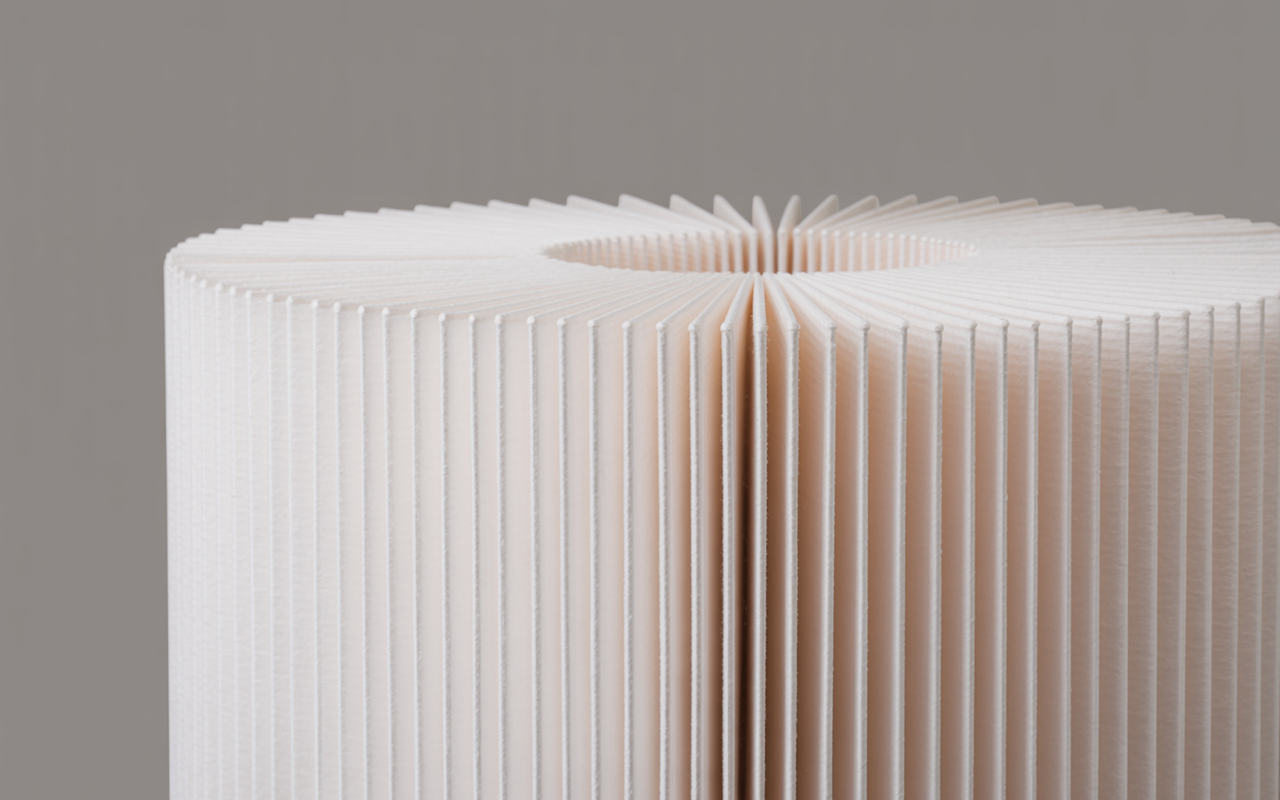
Mini-Pleat HEPA Media: Why Pleat Geometry Changes Performance
Mini-pleat HEPA filters are often chosen for high-efficiency air handling because they pack a lot of media into a compact frame. What is easy to miss is that the pleat shape is not just a manufacturing detail — it directly affects resistance to airflow, how the filter loads with dust, and whether it fits the housing correctly.
For industrial buyers and contractors, understanding pleat geometry helps avoid nuisance problems such as premature pressure drop rise, uneven dust loading, bypass around the seal, and installation issues when the filter lands on site. The right geometry depends on the duty, the system pressure available, and the physical dimensions of the housing.
Why pleat geometry matters in HEPA media
Mini-pleat HEPA media uses closely spaced folds to increase the effective surface area within a compact footprint. In simple terms, the media can expose more area to the airstream without making the filter physically larger.
That extra area is only useful if the pleats are formed and supported properly. If the geometry is too tight, airflow can become restricted and the filter may load faster than expected. If the geometry is too open, the filter may not use the available media efficiently, which can affect performance and fitting in the frame.
The key variables are:
- •Pleat depth
- •Pleat spacing
- •Separator or support design
- •Media stiffness and bonding
- •Frame dimensions and sealing method
Each of these influences how air moves through the filter and how the dust cake builds over time.
Pleat depth: more depth is not always better
Pleat depth refers to how far the media folds extend from valley to peak. Deeper pleats can increase usable media area, but only if the air can still move evenly through the pack.
When pleats are too deep for the design, a few things can happen:
- •Air may favour the outer sections of the pleat pack, leaving deeper areas underused
- •The filter can be more vulnerable to pleat crowding if the pack is compressed in the housing
- •Dust may accumulate unevenly, which can make pressure drop rise more quickly in practice
Shallower pleats can be easier to support and may behave more predictably in compact housings, but they offer less media area in the same face size. The right balance depends on the available installation depth and the airflow pattern through the bank.
For buyers comparing products, it is worth checking the effective dimensions as well as the nominal size. If you are unsure how to measure the opening, how to measure an air filter is a useful starting point before placing an order.
Pleat spacing and airflow resistance
Pleat spacing is one of the biggest factors in initial resistance. Closely packed pleats can increase the chance that adjacent folds interfere with each other, especially when the air velocity is uneven or the media is flexible.
What tighter spacing can do
Tighter spacing may help fit more surface area into the filter, but it can also:
- •Reduce the free flow path between pleats
- •Increase resistance at the start of service
- •Make the filter more sensitive to dust loading if airflow is not well distributed
What wider spacing can do
Wider spacing can improve air access to each pleat and may support more even loading. However, if the spacing is too wide for the frame size, the filter may lose media area and not make the best use of the housing depth.
In practical terms, contractors should consider the whole system, not just the filter element. Duct layout, face velocity, fan capability and pre-filtration all influence how the mini-pleat pack behaves once installed.
If the application has challenging dust conditions, it may also be worth looking at upstream stages in the filtration train. Our products page covers a range of options for different installation needs.
Support structure: holding the pleats where they need to be
Mini-pleat media needs support so the folds stay separated under airflow. This is where hot-melt beads, separators, spacers or other support features become important.
A good support design helps the pleats keep their shape during operation. That matters because collapsed or distorted pleats can reduce effective media area and create localised loading points. Over time, that can lead to uneven resistance across the filter face.
Support design should also suit the frame and installation method. If the support is too intrusive, it can block useful media area. If it is too light, the pleats may move or touch under load, especially in systems with variable airflow.
For high-efficiency filters, the objective is not simply to hold the media together. It is to maintain a stable geometry that allows the full pack to work as designed.
Loading behaviour and service life in real systems
Dust loading is rarely uniform. The way a filter loads depends on the particle mix, the amount of pre-filtration, the airflow profile and how well the pleats are supported. A well-designed mini-pleat can spread loading across a large area, which helps maintain more stable resistance over time.
Poor pleat geometry can concentrate loading in certain zones. When that happens, one section of the media reaches its limit before the rest of the filter has been fully used. The result is a filter that appears to “fill up” early even though the whole surface area was not working evenly.
For site teams, the practical signs to watch are:
- •Faster-than-expected pressure drop rise where gauges are fitted
- •Visible dust tracking across only part of the filter face
- •Distorted pleats or frame movement during inspection
- •Gaps or leakage around the seal due to poor housing fit
Inspection frequency depends on the system, site conditions and dust load. Follow the filter and equipment manufacturer instructions, and monitor pressure drop where gauges are fitted.
If your site has changing process dust, construction activity or variable outdoor air quality, filter servicing or commercial filter servicing can help keep the system under review.
Housing fit: the detail that can make or break performance
A HEPA filter can be well made on paper but still perform poorly if it does not fit the housing correctly. Mini-pleat filters rely on accurate dimensions, flat sealing surfaces and proper installation to avoid bypass.
Things to check before ordering or replacing a filter include:
- •Exact length, width and depth of the housing opening
- •Seal type and sealing surface condition
- •Access clearance for removal and installation
- •Whether the frame can accommodate the full pleat pack depth
- •Any clamps, retainers or service hardware that may compress the filter
This is especially important where housings were built to suit a specific filter construction. A small change in pleat depth or frame profile can create installation issues even if the nominal size looks correct.
If a site has modified ductwork, retrofitted equipment or unusual framing, a custom solution may be the best path. custom air filters can help when standard sizes are not the right fit.
Choosing the right mini-pleat HEPA filter for the job
When specifying or replacing a mini-pleat HEPA filter, start with the system requirements rather than the media alone. Ask how the filter will behave in the actual housing, at the actual airflow, with the actual dust load.
Useful questions include:
- •What is the available installation depth?
- •Is the housing designed for deep or shallow pleats?
- •Is upstream filtration already in place?
- •Is the seal face in good condition?
- •Does the site need H13 or H14 performance at the most penetrating particle size under EN 1822?
H13 is at least 99.95% efficient and H14 is at least 99.995% efficient at the most penetrating particle size under EN 1822. If the project is tied to ventilation design, site requirements should be confirmed with the mechanical services engineer or building owner, including any relevant considerations under AS 1668.2:2024.
Where a product is described as washable, that applies only to specific products. Some filters are designed to be washable - check the product instructions.
Need help matching pleat geometry to your filter housing?
Total Air Filtration is a family-owned air filter manufacturer and supplier in Hillcrest, Brisbane QLD, established 2009. We can help supply or make the right filter for your application, whether you need a standard size or a custom fit.
Call 07 3800 3448 or request a quote. You can also browse our products or contact us if you need help matching a filter to an existing housing.
Written by
The Total Air Filtration Team
General information only — always follow the instructions for your filter and system. Have questions about this article? We're here to help.