
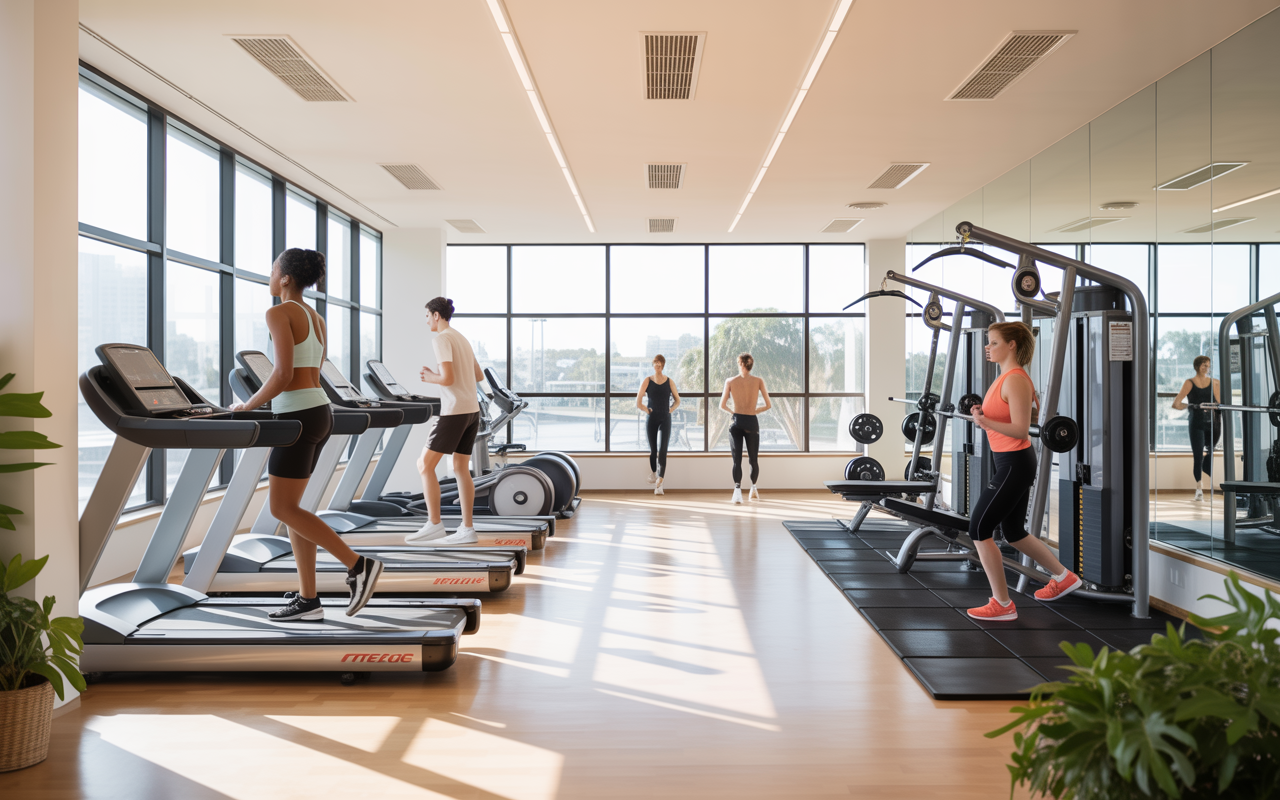
How to Interpret PM Readings in a Gym During Peak Occupancy
Gym PM readings often look different at peak times because a workout space is a changing environment, not a steady one. People move in and out, equipment stirs dust, and ventilation can be stretched by higher occupancy, so a brief rise in particle levels does not always mean the same thing from one day to the next.
For gym operators and facility managers, the key is to read the numbers in context. A sensor can tell you that particle levels changed, but it cannot tell you by itself whether the cause was foot traffic, chalk, cleaning, a ventilation change, or a filter that needs attention.
Why particle levels rise in gyms
Gyms are active spaces with many particle sources. During peak occupancy, the mix of people, movement and airflow can create short-term spikes that are easy to misread if you only look at a single reading.
Common reasons PM levels rise include:
- •More occupants breathing, talking and moving through the space
- •Treadmills, bikes and weights disturbing settled dust from floors and surfaces
- •Chalk, grip powders and some cleaning activities releasing fine particles
- •Entry doors opening more often, allowing outside air and dust to enter
- •Higher air movement from fans or HVAC systems lifting particles already in the room
It is also worth separating particle readings from odour, heat and stuffiness. A gym can feel busy and uncomfortable even when particle levels are moderate, and it can show elevated PM readings without a strong odour or obvious haze.
Reading PM data alongside occupancy
A PM sensor is most useful when you compare it with what is happening in the room at the same time. Occupancy patterns matter because a busy class, a packed free-weights area and a quiet recovery zone can all produce different readings.
When reviewing data, ask:
- •Is the increase tied to a specific class time or a general busy period?
- •Does the reading climb quickly when the room fills, then settle after traffic drops?
- •Do spikes happen near entrances, reception, studios or high-motion training areas?
- •Are readings higher during cleaning, floor sweeping or equipment wiping?
Short spikes can be normal in an active gym, especially when the space is full. What matters is the pattern over time. If the PM level stays elevated well after occupancy drops, that can point to ventilation, filtration or housekeeping issues rather than just people in the room.
It helps to keep notes on class schedules, opening hours, cleaning times and any maintenance events. Even a simple record can make sensor trends much easier to interpret.
Ventilation patterns can change the reading
Air movement has a major effect on how particles behave in a gym. If supply air is uneven, return air is blocked, or the system is not moving enough air for the current load, particles can linger longer in occupied zones.
Useful things to review include:
- •Whether the ventilation system runs differently before opening, during peak use and after hours
- •Whether air is being supplied and returned as intended in the main training areas
- •Whether ceiling diffusers, grilles or returns are obstructed by signage, storage or equipment
- •Whether doors are propped open in a way that changes the designed airflow pattern
If your site has demand-based control or staged operation, PM readings may rise and fall with airflow changes rather than occupancy alone. A gym that becomes busier late in the day may need a different ventilation response than one that is busiest in the morning.
For sites under design review or upgrade, ventilation requirements should be confirmed with the mechanical services engineer or building owner, and relevant site requirements should be considered alongside AS 1668.2:2024.
What filter condition can tell you
If your air handling system uses filters, a rising pressure drop can indicate that the filter is loading with dust and particles. That does not automatically mean the gym air has become worse, but it does mean the system may be working harder to move air through the filter.
Check the filter system when you see:
- •A sustained rise in PM readings without a clear occupancy change
- •Reduced airflow at supply outlets
- •Dust build-up around grilles, returns or plant areas
- •A pressure gauge showing a higher differential than normal for that system
Inspection frequency depends on the system, site conditions and dust load. Follow the filter and equipment manufacturer instructions, and monitor pressure drop where gauges are fitted.
If you are unsure what filters are installed, or whether a change in filtration would suit the system, it can help to review the current sizes, frames and media type before ordering replacements. Our how to measure an air filter guide is a practical starting point.
How to tell a normal spike from a problem
Not every PM rise needs immediate action. The question is whether the reading matches the activity in the room and whether it settles as expected once conditions change.
A spike is more likely to be operationally normal when:
- •It occurs during class changeover or peak use
- •It drops after occupancy falls
- •It lines up with cleaning or equipment movement
- •It appears in one zone rather than throughout the whole venue
A spike deserves closer review when:
- •It persists when the room is quiet
- •It appears across multiple spaces at once
- •It repeats at the same time with no clear activity pattern
- •It coincides with reduced airflow or signs of blocked returns
If the readings are consistently difficult to interpret, check whether the sensor location is suitable. Sensors placed too close to doors, vents or a dust source can misrepresent the conditions in the rest of the gym.
Practical steps for gym operators
A simple monitoring routine can make sensor data much more useful. You do not need a complex system to start identifying patterns.
Focus on these basics:
- •Compare PM readings with occupancy, cleaning times and class schedules
- •Check whether ventilation changes during busy periods
- •Record when filters were inspected and whether pressure drop has changed
- •Keep return air paths and diffusers clear of obstructions
- •Review whether some zones need different air distribution from others
If the system needs attention, replacement filters should match the equipment and the site requirements. Some filters are designed to be washable - check the product instructions before cleaning or reusing them.
If you need a broader range of filtration options, see our products or explore filter servicing and commercial filter servicing for support with maintenance planning.
When to get help
If PM readings keep rising during normal trading hours, or if you are unsure whether the issue is ventilation, filtration or the way the sensor is positioned, it is worth getting the system checked. A mechanical review can help separate occupancy effects from airflow or filter issues.
Total Air Filtration is a family-owned air filter manufacturer and supplier in Hillcrest, Brisbane QLD, established 2009. We can help supply or make the right filters for your gym system, including custom air filters where required.
Call 07 3800 3448 or request a quote to discuss the filters and servicing your site needs.
Written by
The Total Air Filtration Team
General information only — always follow the instructions for your filter and system. Have questions about this article? We're here to help.