
HEPA Filter Construction: What Makes a Filter Truly High-Efficiency
HEPA filters are often talked about in terms of efficiency ratings, but the construction behind the rating is what determines whether a filter performs as intended in service. For homeowners, facility managers and industrial buyers, understanding the parts inside the frame can make it easier to compare products, specify the right unit, and avoid filters that look similar on paper but behave differently in a system.
A true high-efficiency filter is not just a sheet of media in a box. The media, spacing, seals and frame all need to work together to hold airflow, capture fine particles and maintain a reliable fit in the equipment.
What the HEPA rating actually tells you
HEPA describes a filter category used for very fine particle capture, but the rating only makes sense when it is tied to the correct test method and leakage control.
Under EN 1822, HEPA filters are classified by performance at the most penetrating particle size, or MPPS. In practical terms, that means the filter is tested at the particle size that is hardest to capture, not just with larger dust particles that are easier to stop.
For HEPA filters:
- •H13 is at least 99.95% efficient at MPPS
- •H14 is at least 99.995% efficient at MPPS
Those figures matter, but they are only part of the story. A filter with excellent media can still underperform if air bypasses around the edges, or if the frame is not rigid enough to keep the seal intact in operation.
It is also worth remembering that MERV, EN 779 and ISO 16890 ratings do not convert directly. If you are selecting filters for a building or process, it is better to compare products using the rating system specified for the application rather than trying to force a simple conversion.
The media: the core of the filter
The media is the filtering material inside the frame. In HEPA construction, it is usually a very fine fibre medium designed to capture tiny particles through a combination of interception, diffusion and other particle-trapping mechanisms.
Good media design is about balance. If the fibres are packed too loosely, particles can pass through more easily. If the media is too dense without enough surface area, the filter may load up quickly and create unnecessary resistance to airflow.
What to look for in HEPA media
- •Uniform fibre distribution across the full media pack
- •Consistent pleat spacing to use the full surface area
- •Media strength that resists tearing or collapse under airflow
- •Low risk of fibre shedding into the airstream
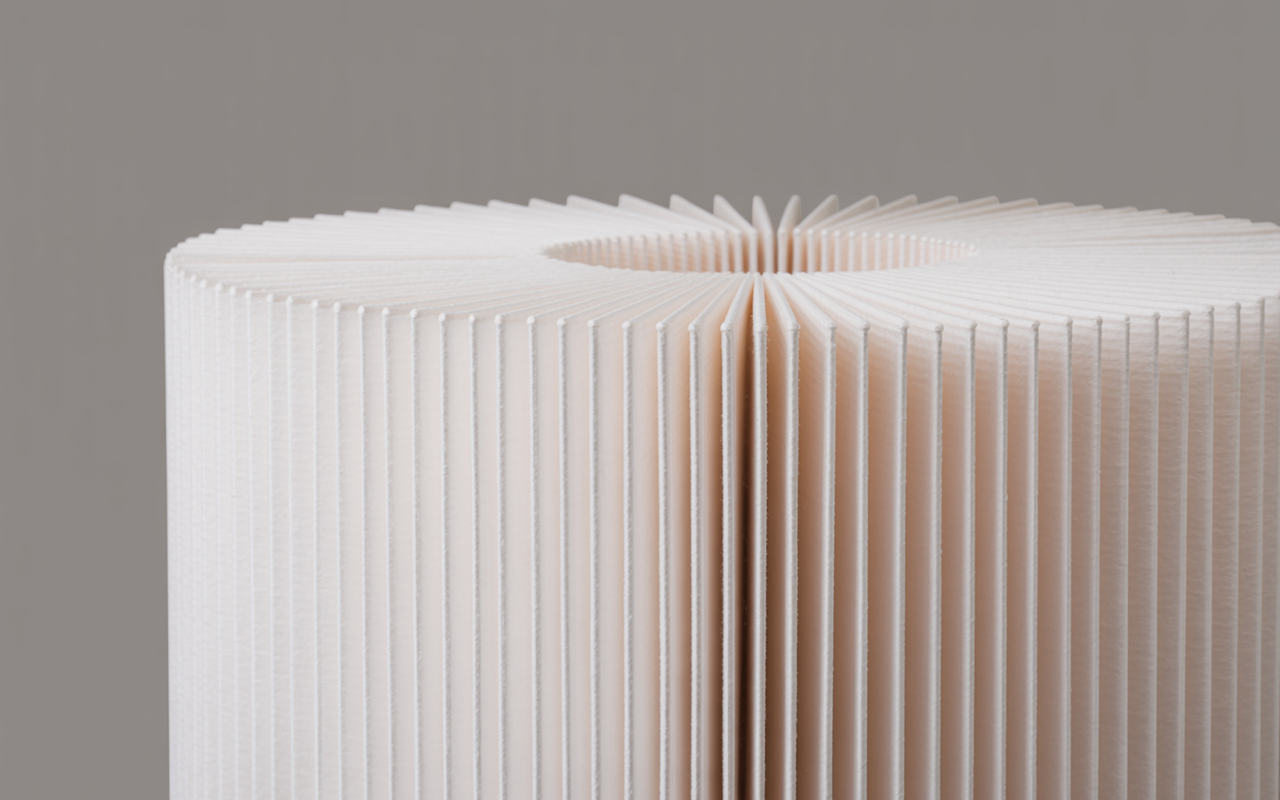
The media is usually pleated or arranged to increase surface area within a compact frame. More usable surface area means the filter can slow the air down through the media, which helps with particle capture and service life. The exact design should suit the airflow, dust load and equipment requirements.
Separators and pleat spacing
In many HEPA filters, separators are used to keep the media folds apart. Their job is simple, but important: they preserve airflow paths between the pleats so the media can do its work evenly.
Without proper spacing, pleats can touch, block each other or create dead spots where air takes the path of least resistance. That can reduce effective filtration area and place extra stress on parts of the media.
Separators may be made from materials such as aluminium, plastic or adhesive bead systems, depending on the filter design. The best option depends on the application, required strength and how the filter will be handled and installed.
When inspecting a HEPA filter, look for:
- •Even pleat spacing from end to end
- •No crushed areas or collapsed folds
- •Clean, consistent separator placement
- •Media that remains secure during handling
If a filter is being used in a demanding environment, such as a clean air system or a process area with fine dust, separator design becomes even more important because airflow stability and structural support are both critical.
Sealing: stopping air from going around the filter
A high-efficiency filter is only effective if air is forced through the media rather than around the edges. That is why sealing is such a big part of HEPA construction.
The filter media may be excellent, but if the gasket, gel seal or frame-to-housing interface is poor, bypass can occur. In practice, leakage around the perimeter can be just as important as the filter media itself.
Common sealing elements
- •Gasket seals that compress against the housing
- •Gel seals used in some housing designs
- •Careful frame-to-housing fit
- •Secure installation and correct clamping pressure
This is one reason fit matters so much. If you need to replace an existing filter, accurate sizing is essential. If you are unsure of the dimensions, how to measure an air filter explains the basics of getting the right fit before you order.
In some applications, the system design and sealing method should also be checked against AS 1668.2:2024 and confirmed with the mechanical services engineer or building owner. Site requirements can vary widely, so it is important not to assume one product suits every installation.
Frame construction and durability
The frame is more than a holder for the media. It keeps the filter rigid, protects the delicate media pack and helps maintain the seal under changing airflow conditions.
A well-built frame should resist warping, cracking or distortion during installation and use. The choice of frame material depends on the application. Some are made from metal, some from board or other engineered materials, and some are designed for heavier-duty service.
A poor frame can lead to problems such as:
- •Air bypass from a distorted seal surface
- •Mechanical damage during handling
- •Media movement or collapse
- •Difficulty fitting the filter into the housing
The frame should also suit the surrounding environment. In sites where moisture, vibration or rough handling is a concern, frame construction becomes a practical performance issue, not just a matter of appearance.
Choosing the right HEPA filter for the job
Not every system needs the same filter design, even if the label looks familiar. A good selection process starts with the equipment, the available space, the airflow rate and the particle loading expected at the site.
For some applications, a standard HEPA panel is suitable. For others, a deeper filter, a specific seal type or a custom size is needed. If your system has unusual dimensions or a non-standard housing, custom air filters can be a better path than trying to make a generic product fit.
It is also worth noting that some filters are designed to be washable - check the product instructions. That does not apply to all HEPA products, so the care method should always match the filter type.
For facility managers and industrial buyers, the practical checks are straightforward:
- •Confirm the required rating and filter class
- •Check the physical dimensions and sealing method
- •Match the filter to the airflow and housing design
- •Follow the manufacturer’s installation and maintenance instructions
- •Monitor pressure drop where gauges are fitted
Inspection frequency depends on the system, site conditions and dust load. Rather than relying on a fixed calendar, use the equipment guidance and the condition of the filter to decide when service or replacement is needed. If your site needs ongoing support, filter servicing and commercial filter servicing can help keep the system on track.
Getting the right filter from a manufacturer who understands the details
At Total Air Filtration, a family-owned air filter manufacturer and supplier in Hillcrest, Brisbane QLD, we work with customers who need filters that fit properly and perform as expected in real systems. We can help supply or make the right filter for your application, whether you are replacing a standard unit or need a custom build.
If you would like help selecting a HEPA filter, or need guidance on sizing, construction or installation, call 07 3800 3448 or request a quote. You can also view our products or contact us for further assistance.
Written by
The Total Air Filtration Team
General information only — always follow the instructions for your filter and system. Have questions about this article? We're here to help.